Disaster Relief & Humanitarian Support
Disasters and crises do not just damage landscapes — they disrupt lives, livelihoods, and the sense of security families hold onto in difficult times. For communities dependent on daily wages and informal work, the impact is even more severe. Interrupted incomes, loss of work opportunities, and restricted mobility often leave families struggling to secure even basic food supplies.
The Impact of Climate Change on Informal Workers
Informal workers in India — who constitute a large majority of the workforce — are among the most vulnerable to climate change impacts due to prolonged exposure to extreme weather, reduced work opportunities, and lack of social protection. India’s informal sector employs around 80–88% of workers, many of whom operate outdoors without shelter or climate safeguards (Greenpeace India, 2021). Studies in urban environments like Delhi found that with every 1 °C increase in temperature, informal workers’ earnings may fall by up to 19%, and during intense heatwaves net earnings can drop by as much as 40%, alongside significant increases in health-related expenses (Greenpeace India, 2021). Estimates also indicate that India has lost hundreds of billions of labour hours annually due to extreme heat, disproportionately affecting outdoor and informal workers and threatening household incomes, food security, and long-term economic resilience (Greenpeace India, 2021).
In addition to sudden disasters, extreme weather and climate-related events increasingly affect informal workers, including domestic helpers, construction laborers, street vendors, and other daily-wage earners. These events damage workplaces and homes, reduce income opportunities, and increase health risks, making timely and responsive relief even more critical.
Recognising this urgent need, NIDAN’s Disaster Relief and Humanitarian Support initiatives focus on extending timely assistance to vulnerable households during emergencies. Our approach is rooted in compassion, dignity, and community participation — ensuring that relief does not merely reach people, but truly supports them in rebuilding their lives.
Supporting Families When It Matters the Most
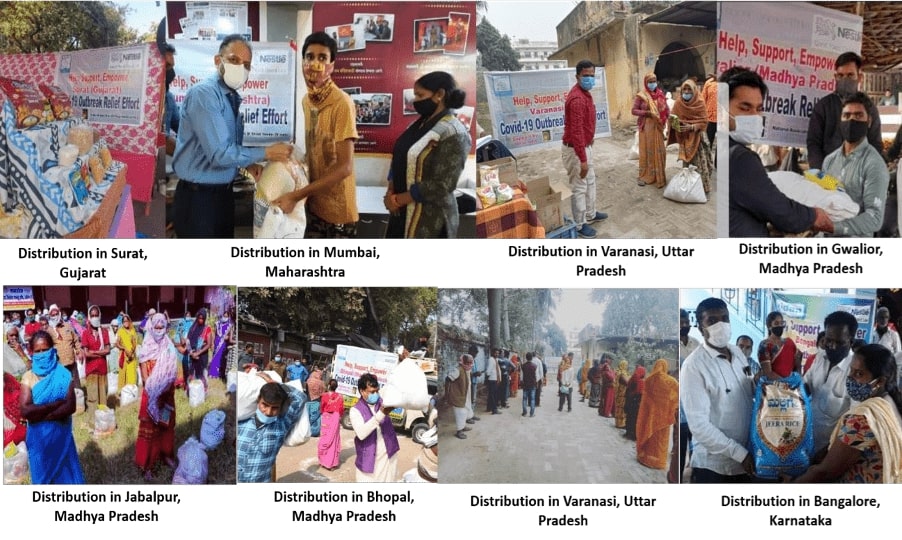
In 2022, under the Nestlé-supported programme, NIDAN facilitated the distribution of dry ration kits across several states, particularly among families impacted by economic hardships, disaster-led disruptions, and vulnerability arising from unstable work conditions.
These ration kits were more than food supplies — they served as a safety net for households facing uncertainty. For many families, the kits helped reduce the immediate stress of securing meals, enabled them to prioritise health and wellbeing, and provided emotional reassurance at a time when survival itself felt challenging.
Reaching Communities Across States
The relief outreach covered diverse geographies — urban neighbourhoods, semi-urban belts, migrant settlements, and disaster-affected regions. Distribution drives were organised in:
- Delhi, where vulnerable urban communities and informal settlements faced food insecurity
- Bihar, supporting programme-linked families across identified districts
- Karnataka — Mysore, Gadag and Bangalore, reaching daily-wage households and low-income communities
- Jharkhand, where economically marginalised families benefited from essential grocery support
- Kashmir, extending assistance to families living in challenging climatic and socio-economic conditions
- Surat, supporting migrant and informal worker families with limited access to social security
- Patiala, where programme networks enabled outreach to vulnerable neighbourhoods
- Assam (Flood Relief), where ration distribution provided immediate support to households recovering from severe flood impact
These interventions ensured that families who are often left unseen during crises were not forgotten, and that relief reached them through structured, compassionate and responsible delivery systems.
What the Ration Kits Meant to Families
Each ration kit was carefully curated to support household consumption needs during times of distress. The kits typically included staple food grains, pulses, cooking essentials, and other basic grocery items that could sustain families for a period of time.
For many beneficiaries, these supplies:
- Reduced the pressure of daily food expenses
- Prevented hunger and nutritional gaps
- Allowed families to redirect limited income to other essential needs such as medicines, rent, or education
In conversations with community members, families expressed that the support did not just feed them — it helped restore a sense of dignity and stability at a time when hope felt uncertain.
Relief Built on Trust, Partnership & Local Engagement
The success of the relief outreach was made possible through strong coordination between:
- Local community leaders and volunteers
- Grassroots programme teams
- Administrative bodies and partner networks
Care was taken to ensure:
- Transparent identification of beneficiaries
- Dignified and respectful distribution
- Equal and fair access for vulnerable households
By working closely with communities, NIDAN ensured that relief was not transactional, but relationship-driven — grounded in trust, accountability, and shared responsibility.
Restoring Hope, Strengthening Resilience
Disaster relief is not only about responding to an immediate crisis — it is also about helping families regain confidence to move forward. Through its dry ration distribution efforts, NIDAN contributed to strengthening resilience among communities who continue to live with uncertainty, fragile livelihoods, and recurring vulnerabilities.
By incorporating the specific challenges faced by informal workers due to climate change, NIDAN’s approach ensures that interventions are proactive, inclusive, and sensitive to emerging risks, helping families withstand both sudden disasters and gradual environmental disruptions.
We remain committed to standing beside families during emergencies — listening to their needs, responding with empathy, and ensuring that support reaches those who need it the most. Because in moments of crisis, solidarity becomes the strongest form of relief — and hope becomes the first step toward rebuilding lives.