
SBIF-Muskaan Project: Strengthening Early Childhood Care and Community Childcare in Jamshedpur

Why Childcare Matters

The early years of a child’s life are foundational for physical growth, language, cognitive development, social-emotional well-being and future learning. Yet, for many families living in vulnerable and low-income urban communities, access to safe, reliable and development-oriented childcare remains limited.

The challenge of childcare is also closely linked with the realities of work. Families, particularly women and primary caregivers engaged in informal, daily-wage   and other livelihood activities, often have to balance earning an income with responsibility for young children. The absence of dependable childcare can affect working hours, attendance at work and the choices available to caregivers.

NIDAN’s baseline assessment in the project communities highlighted a strong demand for organised childcare. Families identified child safety, early learning, nutrition, flexible care arrangements and support for working caregivers among their key expectations from crèche services. The assessment also found instances where caregiving responsibilities affected work schedules or resulted in caregivers taking children to their workplaces.

Recognising this connection between children’s development, care responsibilities and family livelihoods, NIDAN views accessible childcare as an essential community service as well as an important part of the wider care infrastructure.
About the SBIF-Muskaan Project

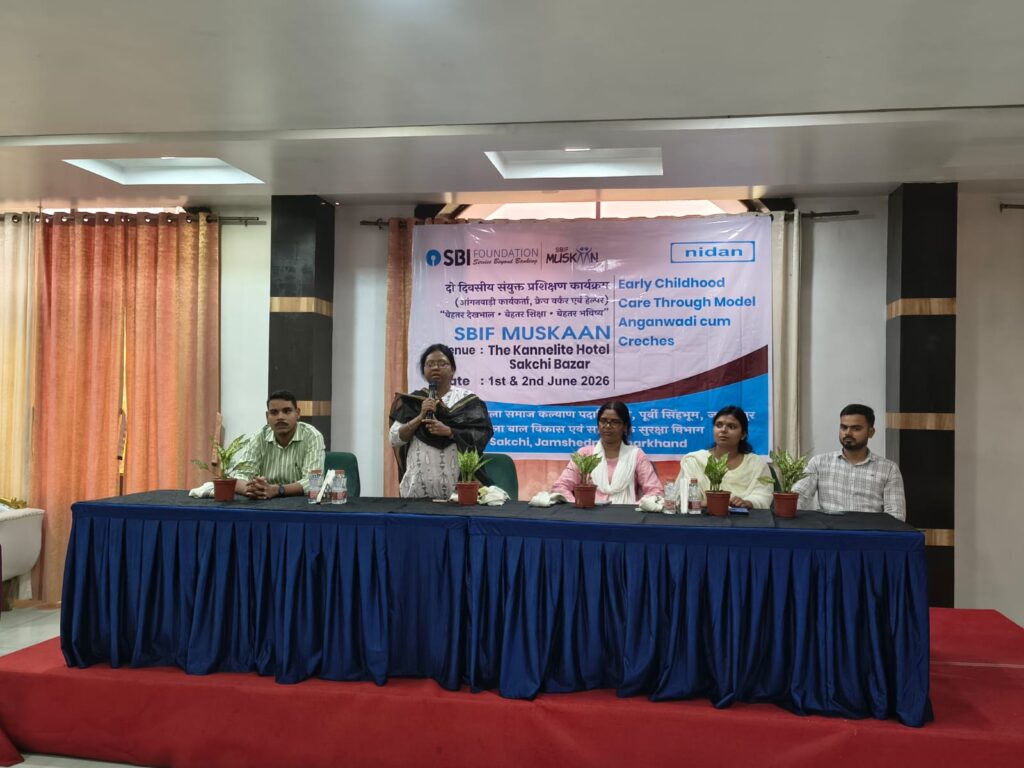
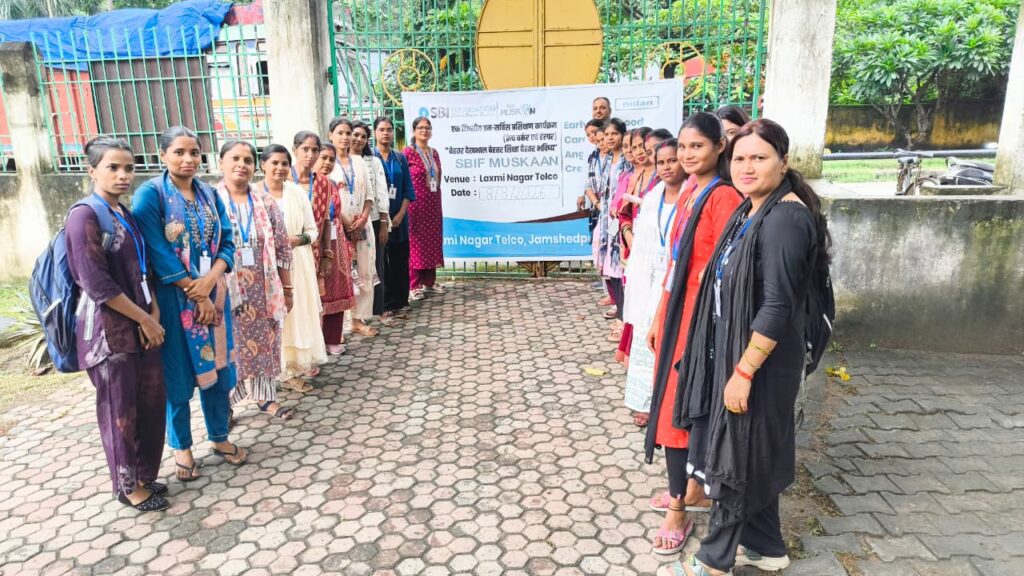
With support from SBI Foundation, NIDAN is implementing the SBIF-Muskaan Project in Jamshedpur, Jharkhand.

The initiative is designed as an integrated Early Childhood Care and Development (ECCD) programme aimed at strengthening childcare support systems for children and caregivers living in vulnerable urban communities. The project works through 11 Anganwadi-cum-Crèche Centres, bringing together childcare, early learning, health and hygiene support, caregiver engagement, community participation and convergence with existing public services.

Rather than viewing a crèche only as a place where children stay during the day, Project Muskaan seeks to strengthen these centres as safe, nurturing and stimulating environments where children can learn, play, interact and develop.

What NIDAN Is Doing

Strengthening Early Childhood Learning

A central focus of Project Muskaan is to promote age-appropriate early learning and developmental stimulation. Children are encouraged to learn through play, storytelling, rhymes, creative activities, conversation, movement and other participatory experiences. The approach recognises that young children learn best through interaction, exploration and everyday experiences rather than through formal classroom instruction.

For younger children, the emphasis is on responsive care and early stimulation, while older preschool-age children are supported through play-based learning and school-readiness activities.

Improving the Quality of Childcare

Quality childcare depends greatly on the people providing it. NIDAN therefore works closely with crèche workers, helpers, Anganwadi Workers and other frontline functionaries to strengthen daily routines, child-centred practices, documentation and centre management.

Regular mentoring, monitoring and supportive supervision are intended to help caregivers understand children’s developmental needs and create more structured, responsive and engaging environments within the centres.

The project’s broader Early Childhood Development framework includes strengthening safe childcare, child health and hygiene, early learning, caregiver capacity, community participation and linkages with government services.

Supporting Health, Nutrition and Hygiene

Children’s learning and development are closely connected with their physical health and nutritional well-being.

Project Muskaan works to strengthen growth monitoring, health-related awareness, hygiene practices, counselling and linkages with existing health and nutrition services.

The project seeks to complement and strengthen existing government systems by improving coordination and helping families access appropriate services for young children.

Engaging Parents and Communities

Child development does not take place only inside the crèche. Parents and caregivers are therefore important partners in the project. Through parent meetings, community interactions and awareness activities, families are encouraged to participate actively in discussions around children’s learning, health, hygiene, nutrition and caregiving.

Community engagement is also essential for building trust in childcare services, encouraging regular utilisation of centres and strengthening local ownership.

Creating Safer and More Child-Friendly Centres

The physical environment of a crèche has an important influence on children’s safety, comfort and ability to learn and play. NIDAN conducts centre-level assessments and field monitoring to identify requirements related to space, sanitation, drinking water, hygiene, safety, learning materials and basic infrastructure. Since every centre operates in a different context, improvements are planned according to centre-specific needs rather than through a uniform approach.

Strengthening Government Convergence

Project Muskaan is implemented in close coordination with the existing Anganwadi and ICDS system. NIDAN engages with frontline functionaries and relevant government stakeholders to ensure that project interventions complement existing public services and contribute to stronger local childcare systems.

This convergence-based approach recognises that sustainable improvements in early childhood care require collaboration between communities, civil society organisations and government systems.

Childcare, Care Work and Women’s Economic Participation

NIDAN’s work in childcare is also connected to a broader understanding of the care economy. Care for young children is essential work, but much of this responsibility continues to be carried by women within households or by poorly supported frontline and informal care providers.

Accessible and reliable childcare can help reduce some of the pressure faced by families in balancing care and livelihood responsibilities. At the same time, strengthening the skills, working conditions and capacities of childcare providers can contribute to greater recognition of care work itself. Through its childcare initiatives, NIDAN is exploring how child development, women’s economic participation and dignified care work can be addressed together rather than as separate issues.

Building Stronger Foundations

The SBIF-Muskaan Project represents NIDAN’s effort to strengthen the ecosystem surrounding young children—bringing together care, early learning, health, families, communities, frontline workers and public systems. The project is not only about improving individual crèche centres. It is also about learning what it takes to create community-based childcare that is accessible, responsive and relevant to the realities of working families.

Through its partnership with SBI Foundation, NIDAN aims to contribute towards a future where every young child has access to safe, nurturing and development-oriented care, while families have greater support to balance caregiving and livelihood responsibilities.

Investing in childcare is an investment in children’s development, women’s opportunities and stronger communities.